

Park · Los Angeles · ⭐ 9.3/10 · 16310 reviews · updated: 2026-08-04 16:03:17
Address: 700 Exposition Park Dr, Los Angeles, CA 90037, United States
Exposition Park — Museums, Roses and a Century of Olympic Memory
A hundred and sixty acres in South Los Angeles carry more civic weight than almost any other patch of the city: three museums, a sunken rose garden older than most of the surrounding blocks, a stadium that has staged two Olympic Games and is preparing for a third, a soccer ground that fills with drums on match nights, and a fourth museum still in its wrappers. Exposition Park sits directly across from the University of Southern California campus, and — unusually for Los Angeles — it is a place you cross on foot, drifting from dinosaur bones to rose beds to the arches of a 1923 stadium in a single afternoon. It is also one of the very few days out in this city that can cost nothing at all.
Highlights
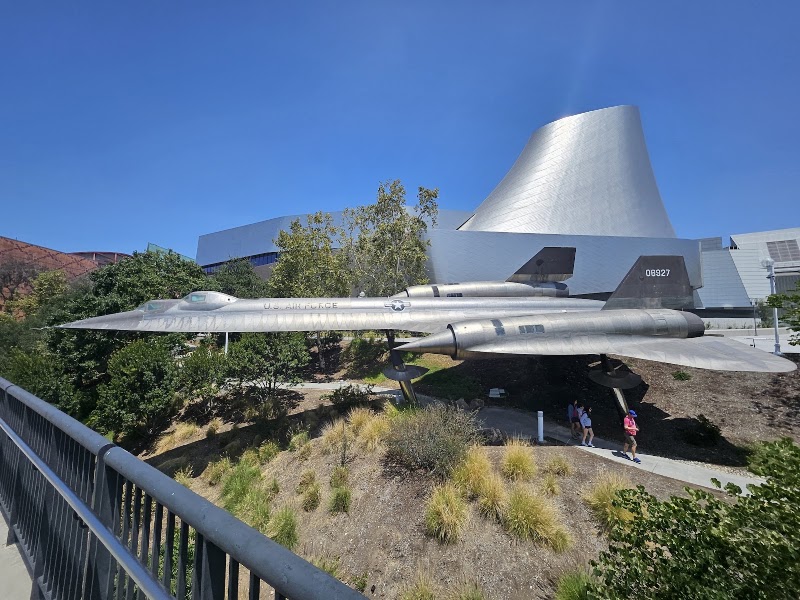
- California Science Center — general admission to the permanent galleries is free with a timed ticket, the largest science museum in the western United States and the most-visited science museum in the country; alongside the aerospace and ecosystems halls it keeps live animals, a kelp-forest tank and a hands-on physics floor.
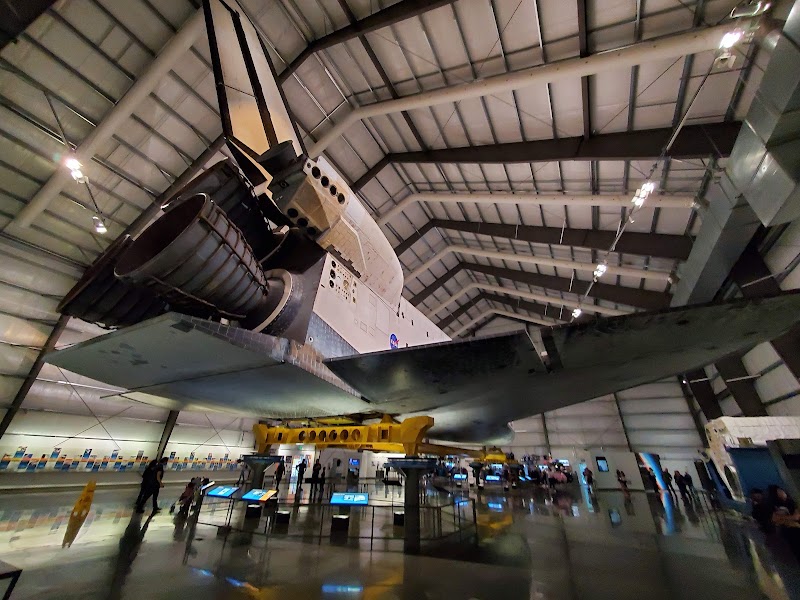
- Samuel Oschin Air and Space Center — the 200,000-square-foot wing that nearly doubles the Science Center’s exhibit space opens on November 13, 2026, presenting Space Shuttle Endeavour vertically in full launch configuration, a twenty-storey stack in a gallery reaching almost 200 feet, with around 100 further aerospace artefacts.
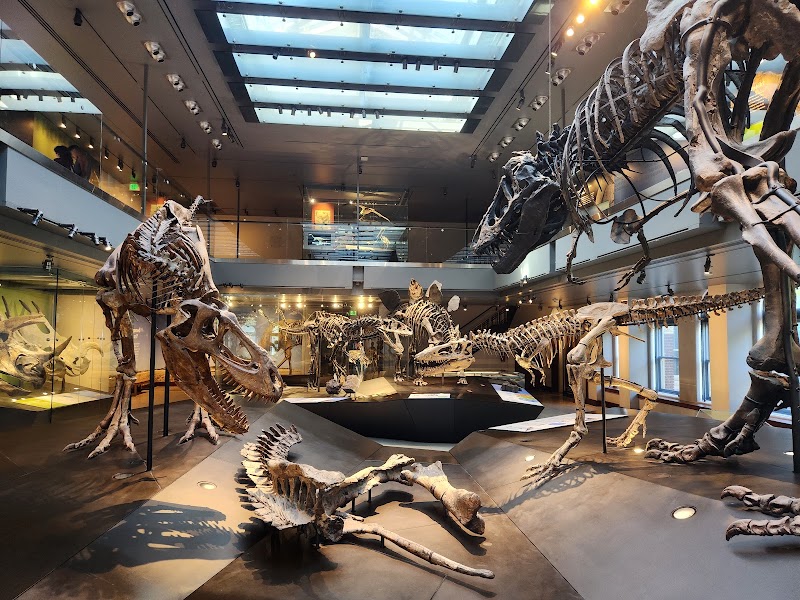
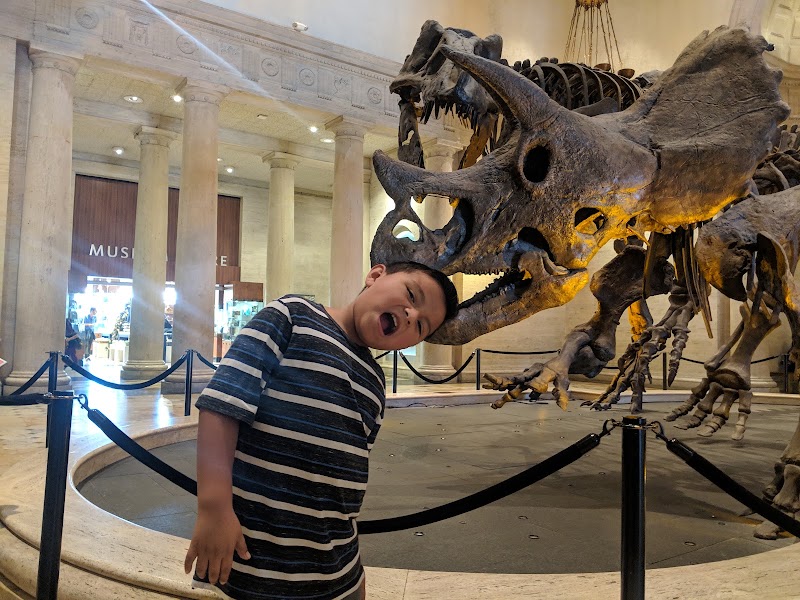
- Natural History Museum of Los Angeles County — dedicated on November 6, 1913 as the Museum of History, Science and Art, the oldest museum in the city and now guardian of some 35 million specimens; its Dinosaur Hall runs a growth series of three Tyrannosaurus rex, and the NHM Commons wing, opened November 17, 2024, added a theatre and the mounted sauropod known as Gnatalie, the first green dinosaur skeleton ever displayed.
- Exposition Park Rose Garden — a seven-acre sunken garden built in 1927 with 15,000 bushes, expanded in the mid-1980s to more than 20,000 plants across some 200 varieties, ringed by four gazebos and centred on a fountain, with four marble figures by the Danish sculptor Thyra Boldsen installed in 1936; listed on the National Register in 1991.
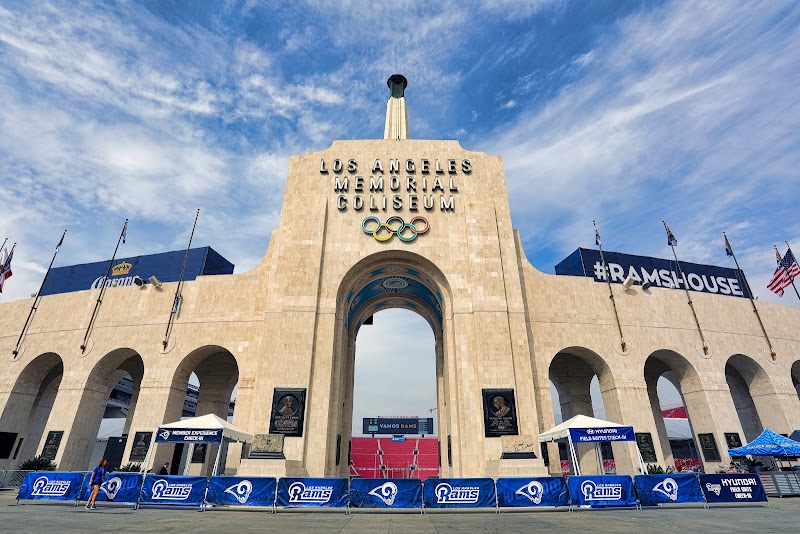
- Los Angeles Memorial Coliseum — designed by John and Donald Parkinson and completed in 1923 as a memorial to the dead of the First World War; a National Historic Landmark since 1984, host of the 1932 and 1984 Olympic Games and, in 2028, the first venue anywhere to serve three.
- BMO Stadium — opened in April 2018 on the footprint of the demolished Sports Arena, a steep, loud 22,000-seat bowl shared by LAFC and Angel City FC and renamed from Banc of California Stadium in January 2023.
What you’ll find
The park reads as a campus rather than a green field: monumental buildings around the edges, formal landscape in the middle, and event crowds that appear and vanish on a published schedule.
- The Lucas Museum of Narrative Art, an eleven-acre campus designed by Ma Yansong of MAD Architects, opening September 22, 2026 with thirty-five galleries of narrative, illustrative and popular art.
- The California African American Museum, founded in 1977 and in its present building since 1984, free to enter and devoted to African American art, history and culture in California and the wider West.
- An IMAX theatre and rotating special exhibitions at the Science Center, both ticketed separately from the free permanent galleries.
- Pergolas, lawns and the central fountain of the rose garden, long the city’s default backdrop for wedding, quinceañera and graduation photographs.
- The EXPO Center with a public swimming pool, gymnasium and sports fields serving the surrounding neighbourhoods, plus wide event lawns that turn into a tailgate on game days.
- The Coliseum’s peristyle at the eastern end, its arches now framing a Court of Honor, with the Olympic cauldron above them — lit in 1932 and again in 1984.
Things to do — and who it’s for
- Families and school groups — an entire day of hands-on science, live animals and dinosaur skeletons with almost no admission charge, which is a rare thing in a city this expensive.
- Space and aviation enthusiasts — once open, the Endeavour display will be the only place on Earth to see a complete, authentic space shuttle stack, orbiter mated to the last flight-qualified external tank and two solid rocket boosters.
- Sports fans — college football in a hundred-year-old bowl and top-flight men’s and women’s soccer next door, two utterly different atmospheres sharing one set of lawns.
- Gardeners and photographers — a formal rose collection big enough to spend an hour comparing hybrid teas, floribundas and climbers, at its fullest in late spring.
- History-minded visitors — Olympic architecture, a 1913 Beaux-Arts museum building and a park that exists because reformers cleaned up a racetrack.
- Budget travellers — two of the museums and the garden cost nothing, so the day’s expense comes down to transport and lunch.
Getting there & practical
The park lies in South Los Angeles, immediately south of the university, and public transport genuinely works here: the Metro E Line stops at Expo Park/USC on the northern edge, leaving a walk of a couple of minutes to the museum doors — a real advantage, because event-day parking is punishing. The grounds are free and open daily. The Science Center’s permanent galleries are free but require a timed reservation booked in advance, while its IMAX films and special exhibitions are ticketed; the Natural History Museum charges admission; the California African American Museum does not. The rose garden opens at 9 a.m. and closes at sunset, and it shuts completely from January 1 to March 15 every year while the bushes are pruned back. Allow half a day for one museum plus the garden, and a full day for two museums or for a visit with children. On Coliseum and BMO Stadium event days, arrive early or come by rail; on ordinary weekday mornings the park is quiet enough to have the rose beds almost to yourself.
When to visit
Spring is the obvious answer: the rose garden reopens in mid-March and peaks through April and May, when the sunken beds are solid colour and the scent carries across the surrounding lawns. Summer here is dry and warm rather than brutal, the ocean tempering the afternoons; mornings are pleasant outdoors, the galleries are cool once the heat builds, and long daylight makes it easy to combine a museum with the garden. Autumn belongs to the stadiums — college football fills the Coliseum on Saturdays and the soccer season runs alongside it — while the clear, dry days after the first heat spells give the sharpest light of the year on the peristyle arches. Winter is mild and green, the quietest season indoors and the best chance of having a gallery nearly to yourself, but it is the wrong time for flowers: the rose garden is closed from New Year’s Day to mid-March and the plants are cut back to bare stubs.
Good to know
The site opened in the 1870s as Agricultural Park, a fairground built around a racetrack, and by the 1890s it had slid into saloons, gambling and general disrepute. William Miller Bowen, a law professor at the neighbouring university, campaigned for years to reclaim it, and together with university president George Finley Bovard assembled backing from the city, the county and the state. The racetrack went, gardens and museums took its place in the spirit of the City Beautiful movement, the grounds were renamed Exposition Park, and the Museum of History, Science and Art was formally dedicated on November 6, 1913. The rose garden was planted in 1927 on the old racing ground. The Coliseum followed in 1923 as a war memorial, and the mere fact that Los Angeles already possessed a stadium of that size helped win the city the 1932 Games; for those Games it was expanded to well over 100,000 seats, and Los Angeles invented the Olympic Village, housing male athletes in more than 500 portable bungalows on a hillside site across town. The Coliseum went on to host the first Super Bowl in January 1967 and the 1984 Olympics, and completed a thorough modernisation in 2019. Space Shuttle Endeavour arrived in October 2012 after a slow two-day tow of roughly twelve miles through city streets, watched by enormous crowds; it was raised into launch position over an all-night operation that finished on January 31, 2024, the first time a shuttle had been stacked anywhere outside a NASA facility.
Visitor tips
- Book the Science Center’s free timed entry online before you travel — walk-up slots disappear quickly at weekends and during school holidays, and the Endeavour wing will make that far worse from November 2026.
- Check the stadium calendars first: a Coliseum or BMO Stadium event turns parking into an ordeal and makes the E Line by far the better choice, while a quiet weekday morning is the best time for the museums.
- If roses are the point of the trip, do not come between New Year’s Day and mid-March; the garden is closed for its annual pruning and there is nothing to see but cut stems.
Questions & answers
Can I see Space Shuttle Endeavour right now? Not yet. The shuttle has been off public view while its permanent home is completed; the Samuel Oschin Air and Space Center opens on November 13, 2026, showing it vertical in full launch configuration.
Which museums are free? The California Science Center’s permanent galleries — with a timed reservation — and the California African American Museum. The Natural History Museum, IMAX films and special exhibitions are ticketed.
Is the rose garden open all year? No. It closes from January 1 to March 15 annually for pruning, then reopens in time for the spring bloom; daily hours run from 9 a.m. to sunset.
How do I get there without a car? Take the Metro E Line to Expo Park/USC; the museums, the garden and both stadiums are a short walk from the platform.
Why does the Coliseum matter? It hosted the 1932 and 1984 Olympic Games and will host again in 2028, making it the first stadium in the world to serve three, and it staged the first Super Bowl in 1967.
What is Gnatalie? A mounted sauropod skeleton whose fossilised bones are naturally green, unveiled with the NHM Commons wing in November 2024 and the first green dinosaur skeleton put on display anywhere.
When does the Lucas Museum open? September 22, 2026, in an eleven-acre campus designed by Ma Yansong, with thirty-five galleries devoted to narrative art.
How much time should I allow? Half a day for one museum and the garden; a full day if you plan on two museums, arrive with children, or want to walk the whole park.
Photos
Show 1 more photos
Visitor reviews
Reviews last updated: 2026-08-04 16:03:17
Data is refreshed monthly. Sources: los-angeles.name and editorial picks based on reviews.
I really loved the open-air atmosphere in this place. There's so much to see and do. We attended a wine tasting here, which was phenomenal .
What An Incredible Place to take in some great sights, take a long walk with a loved one through the rose garden, and marvel at the History that surrounds this place.
What's also so Incredible are the free museums that…
⭐⭐⭐⭐⭐ 5-star review
Exposition Park is a great place to visit! We stopped by and took a walk after coming out of the California Science Center, and it was such a pleasant experience.
The views are really wonderful,…
Although the flowers are in bloom, it's a bit duller here now than it was many years ago. But it's always nice to stop by, since it's right next to the History Museum and the Science Center. I will say I wish there were…
The overall impression was good.
However, in places it felt a bit dated. We couldn't use the crafts area at the end, because they stopped letting people in 45 minutes before 5 p.m. The paid attraction in the space area w…