

The story began with the discovery of gold nuggets in the Sacramento Valley. This event occurred in 1848 and sparked the development of American history throughout the first part of the nineteenth century. News of the discoveries had spread at incredible rates, with the number of would-be gold diggers growing more and more each day. Los Angeles Name will reveal more about how people sought wealth and how that desire clouded their minds.
Gold Rush
So, thousands of gold diggers set out for San Francisco. Some traveled by land, but some sailed by sea. By late 1848 to 1849, the non-native population had grown to about 100 thousand people. When you compare it to the population before the Gold Rush, which was only a thousand people, the difference is really striking.
The peak of events was in 1852, for it was then that precious metals with a total value of $2 billion were recovered.
The story of James Wilson Marshall, who found flakes of gold in the American River at the foot of the Sierra Nevada Mountains (California) on January 24, 1848, was inspiring. The man was a carpenter and was working on a water-powered sawmill construction job on January 24, 1848.
After making his treasured find, Wilson recounted how anxious he was, for he was convinced of one thing that it was gold. The Treaty of Guadalupe Hidalgo was signed at Sutter’s Mill within days of a New Jersey carpenter finding gold. Due to this formal document, the end of the Mexican-American War was finally brought to the table.
The curious thing is that John Sutter, for whom Marshall worked, was a Swiss citizen of German origin. He founded the colony of Nueva Helvetia, which subsequently became the city of Sacramento. The man enslaved hundreds of Native Americans, using them as free labor as well as to defend his domain.
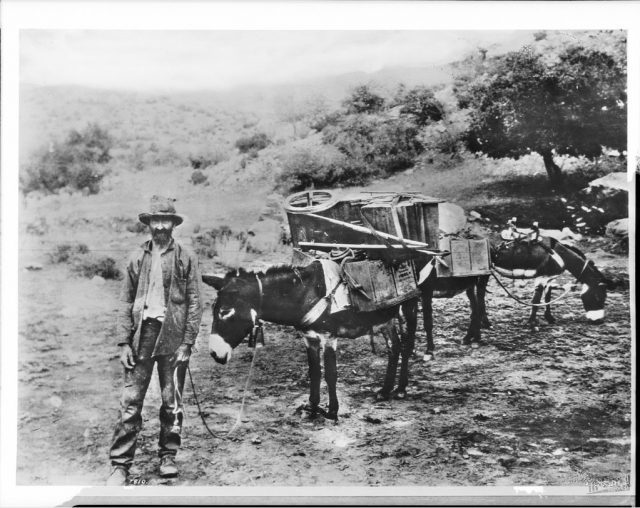
The unceasing search for gold
Despite Sutter and Marshall’s attempts to hide the news of the gold find, the truth was revealed in one of the newspapers. San Francisco residents initially took that news with disbelief, but by mid-June 1848, about three quarters of the men’s population had left the city. They were lured by the gold mines. By the end of the summer, the number of miners had grown to four thousand.
People across the globe have heard of others getting an easy fortune in California. As a result, the first migrants came from Mexico, Chile, Peru, China and other countries.
The press and the Gold Rush
Initially, the sentiment of the press representatives was primarily skeptical. In late 1848, President James K. Polk spoke of the favorable results of the military governor of California, Col. Richard Mason. All the country heard about it, as the president took time out in his inauguration speech.
1849 became a period of people with a gold rush. They were predominantly men who borrowed money and mortgaged their homes on a massive scale. They spent whatever savings they had just to get to California. These men were leaving their families, their hometowns and traveling to nowhere, hoping to find the coveted treasure.
In the wake of this pursuit of gold, women and children were left behind, with new burdens falling on their shoulders. We are speaking about running a farm or a business in addition to taking care of their children.
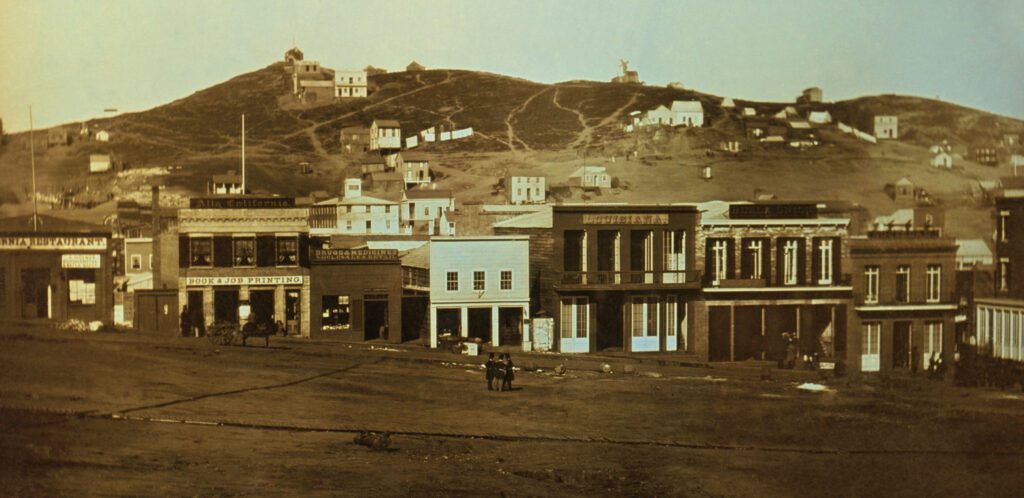
Gold mining towns
As the number of people grew steadily, entire gold-mining towns sprang up. Stores and saloons, brothels and individual businesses opened up there at an incredible pace. All of them were eager to make money, as well. The difference between such establishments was that they did not seek gold themselves but catered to its seekers. It was a viable way to earn a fortune of your own.
At the same time, the mining camps had become overpopulated. The lawlessness was spreading in the towns, involving gang violence, the spread of gambling and alcoholism, along with prostitution and violence.
Nevertheless, the Gold Rush was also a positive influence, as it hastened California’s entry into the Union as the 31st state. Under the Compromise of 1850, California accomplished this by entering the Union as a free state.
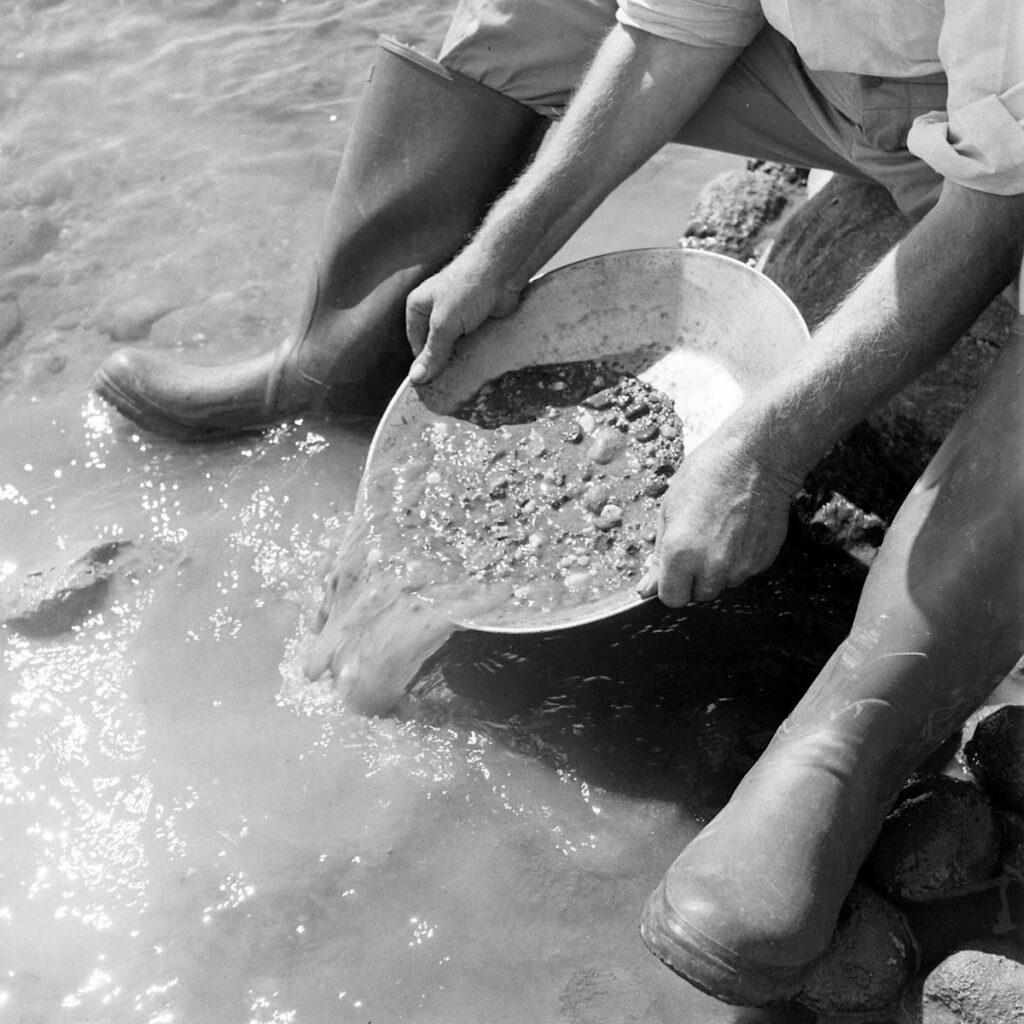
The fate of California’s mines
Already by 1850, the surface gold in California was almost completely gone. However, that did not stop the miners from continuing to arrive. Although mining had always been backbreaking and extremely dangerous labor, the daily wages had decreased dramatically since 1848.
Miners increasingly favored wage labor. In 1853, specialized machinery designed for hydraulic mining was developed. The new machinery generated considerable revenues while destroying a portion of the region’s landscape.
Gold Rush and its impact on California
California’s landscape has changed forever. Here are the primary head notes:
- The new machinery made enormous profits for its owners while destroying part of the landscape.
- Dams have changed the riverbeds designated for agricultural purposes. Sediment from the mines contaminated the water.
- The Gold Rush spurred the development of the logging industry. At the time, there was an urgent need for the construction of massive canals to feed the mines’ boilers.
Hydraulic mining was banned by court order in 1884, with agriculture subsequently becoming the dominant industry in California. Although the days of the Gold Rush times are far behind us, much of its heritage is preserved in places like this.
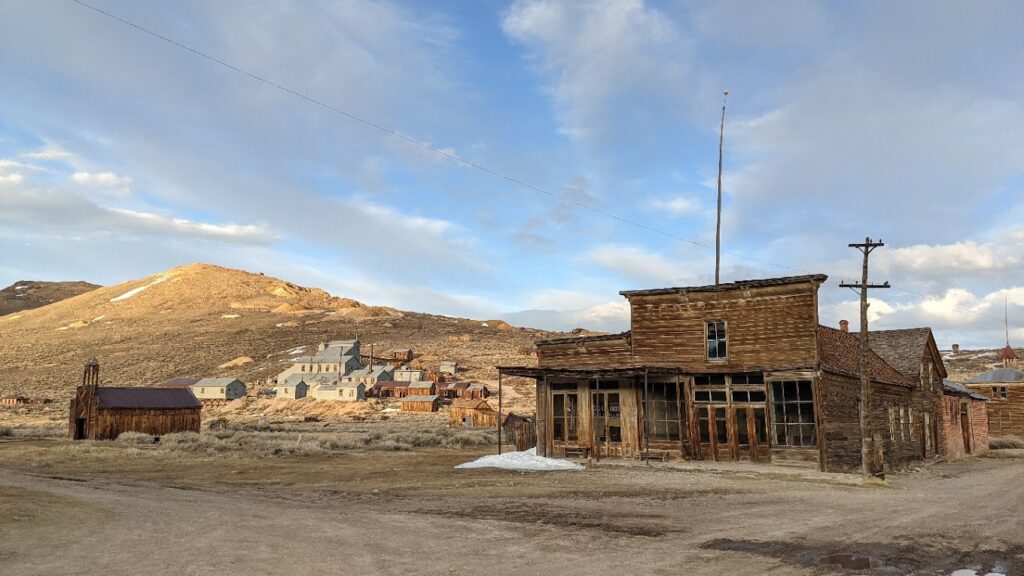
- Bodie State Historic Park. It is a ghost town “frozen in time.” Bodie received historic park status in 1962. Since then, it has remained in such a form. The authorities opted not to make any changes or restore the buildings but to leave them as they were. It harkens back to the 1880s.
- Marshall Gold Discovery State Historic Park. It is a ghost town and also a National Historic Landmark District with the James Marshall Monument and the site where he found gold in 1848. The historic park was established in 1942 and is 576 acres in size.
Fascinating facts about the California Gold Rush
- For the first time, the history of the Gold Rush began not in California but in North Carolina. There, gold seekers managed to find a 17-pound nugget. What is also interesting is that all gold coins issued by the US Mint were made from gold found in North Carolina.
- For foreign miners, the Gold Rush proved dangerous, if not lethal. California’s Native Americans, however, have been hit the hardest. In particular, those involved are mine-related illnesses and accidents. Beatings, violence and even murder were prevalent, as those who had left their homes and lost everything they had got were furious and sometimes even mad.
- The gold seekers were exclusively men, while women who sought work worked in saloons, hotels and restaurants. In 1860, approximately 19% of women worked in gold mining settlements, numbering about ten thousand people. Few women accepted the offer to go west, as the reasons for their apprehension were understandable.
- Merchants in gold mining towns enriched themselves much more than miners. One of the most well known success stories involves Levi Strauss, a tailor who came to San Francisco in 1850 to open a store with tarps and coverings for miner’s wagons. Back then, sturdy work pants that could withstand 16-hour shifts were in high demand. He opened a store downtown, after which turning the idea into a veritable manufacturing empire well known as Levi’s.
Another interesting fact is that miners extracted over 750 thousand pounds of gold during the California Gold Rush. People dreamed of the California Dream, i.e., the idea of becoming rich fast. Later, it inspired filmmakers to create a lot of films, or even series and animated films, through which the viewer was brought to events of the past.