

The 1934 transcontinental run of the Union Pacific Railroad’s diesel-electric M-10001 became a record-breaking event. This journey was a landmark moment in U.S. rail history, showcasing the new rolling stock’s technical prowess and marking the dawn of a new era in passenger travel. You can learn more about this at los-angeles.name.
The Streamliner’s History
Union Pacific’s first Streamliner, the M-10001, became its most famous motorized passenger train. Launched in 1934, the train was a yellow-and-brown, lightweight passenger set featuring four cars and a 600-horsepower internal combustion engine. Though initially intended for demonstration rather than profit, that purpose soon changed.
Diving a little deeper into American rail history, diesel-electric variants had been operating in stations since 1925. Even then, these trains showed excellent results in terms of efficiency, economy, and accessibility. For example, a simplified gas-electric train design, known as the “McKeen car,” was developed and widely purchased and used by other railroads.
The mid-1930s marked the first appearance of diesel internal combustion engines on the Union Pacific. This period saw the launch of the M-10001 passenger train, followed by the M-10002 passenger locomotive in 1936. The trains were tested by the rigors of the road and time, but the shift to diesel power was a complex process fraught with disagreements and public skepticism.
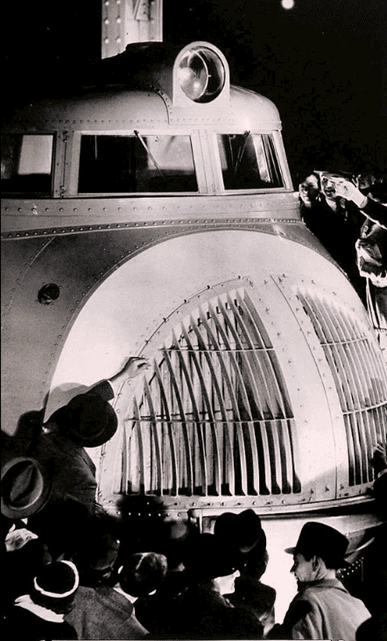
The M-10001: Technical Marvel
This diesel-electric train departed Los Angeles at 10:00 PM on October 22, 1934, intending to set a new U.S. transcontinental speed record. The train arrived at New York’s Grand Central Terminal at 9:57 AM on October 25.
Several technical specifications of this groundbreaking train deserve special attention:
- The train featured state-of-the-art diesel engines. These powered electric generators, which in turn supplied energy to the traction motors. This was a massive leap forward compared to the steam locomotives that dominated the rails at the time.
- The M-10001 was the first diesel-powered sleeping car passenger train in North America. The cars were outfitted with amenities necessary for a comfortable journey, including sleeping compartments, a dining car, and a lounge.
- The train could achieve high speeds and cover significant distances in a short time. For instance, the train was capable of reaching speeds up to 120 miles (193.1 kilometers) per hour, covering a total distance of 3,334 miles (5,365.6 kilometers).
The Record and Its Legacy
The previous speed record, set in 1906 by a train belonging to Union Pacific’s then-chairman and rail baron E. H. Harriman, was surpassed thanks to railway innovation and increased efficiency. The 1934 journey beat the 1906 record by 13 hours and 30 minutes.
The record-breaking Los Angeles-to-New York trip in 1934 conclusively demonstrated the superiority of diesel over steam power, stimulating further development in rail transport. Additionally, diesel locomotives proved to be significantly more economical to operate than steam engines, and their comfortable conditions were far more appealing to passengers.
Notable Passengers Aboard the M-10001
The train carried many prominent figures of the time, underscoring their interest in the event and their desire to be part of a landmark moment in rail history.
- Aboard the train was W. Averell Harriman, the son of E. H. Harriman (who set the previous 1906 record). Harriman was a representative of the family dynasty central to the development of U.S. rail transport.
- Union Pacific President Carl Gray naturally attended the momentous event.
- Inventor Charles F. Kettering, who played a key role in developing the M-10001’s engine.
- Famous Hollywood actors of the era, namely Anita Louise and Henry Hull, were also passengers. It can be assumed they were specially invited to promote the event.
This moment of rail history and technological progress inspired William W. Kratville to write a book. His work, a definitive study of the Union Pacific’s high-speed train era, offers deep insight into the technical specifications, history, and operation of various models. Moreover, the book is filled with photos, diagrams, and illustrations that are hard to find publicly. It is worth noting that William W. Kratville is a recognized expert in rail transport, which is why his research stands out for its high accuracy and detail.
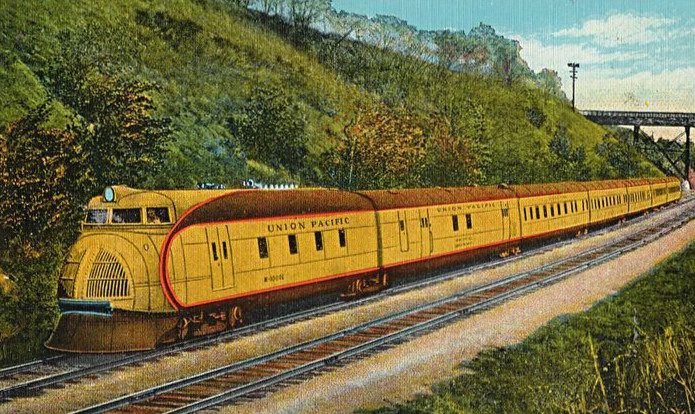
Union Pacific’s Diesel Transition
Despite the successful, record-breaking run of the M-10001 diesel-electric train in 1934, Union Pacific management remained skeptical about the capability of diesel locomotives for freight transport. In their view, the powerful steam locomotives of the time (such as the 2-8-2, 2-10-2, etc.) were far better suited for the task.
The corporate culture at Union Pacific, which had been shaped during the steam era, also initially created resistance to change. Furthermore, steam locomotive manufacturers were reluctant to abandon their traditional products, and they continued to assure others that diesels could not provide the necessary power and speed for heavy freight hauling.
Eventually, it became clear that diesel locomotives were far more economical than steam, were less polluting, and were favored by passengers due to increased comfort. This realization is why diesel power gradually came to dominate rail transport.