

More than just a critical transport artery connecting San Pedro and Terminal Island, the Vincent Thomas Bridge is a unique engineering marvel. It masterfully blends classic suspension bridge technology with innovative solutions. Its design was considered an engineering breakthrough of its era, and the bridge continues to play a vital role in the logistics infrastructure of the Port of Los Angeles. Read more on los-angeles.name.
History of Its Creation
The idea for the bridge originated with local politician Vincent Thomas. Starting in 1940, it took him nearly two decades to secure the necessary legislative approvals for the bridge’s construction. A total of 16 legislative acts were required, and only after years of persistent effort did the project finally become possible.
During those early years, the project often faced heavy criticism and the bridge itself was mockingly dubbed “The Bridge to Nowhere.” However, the situation dramatically changed just a few years after its opening when the bridge became a key logistics link for the Port of Los Angeles.
Before the bridge, the connection between San Pedro and Terminal Island was served by several options:
- Private ferries, which had operated since 1870;
- A municipal ferry service, launched in 1941;
- A pedestrian bridge built during World War II;
- The Commodore Heim lift bridge, which opened in 1948.
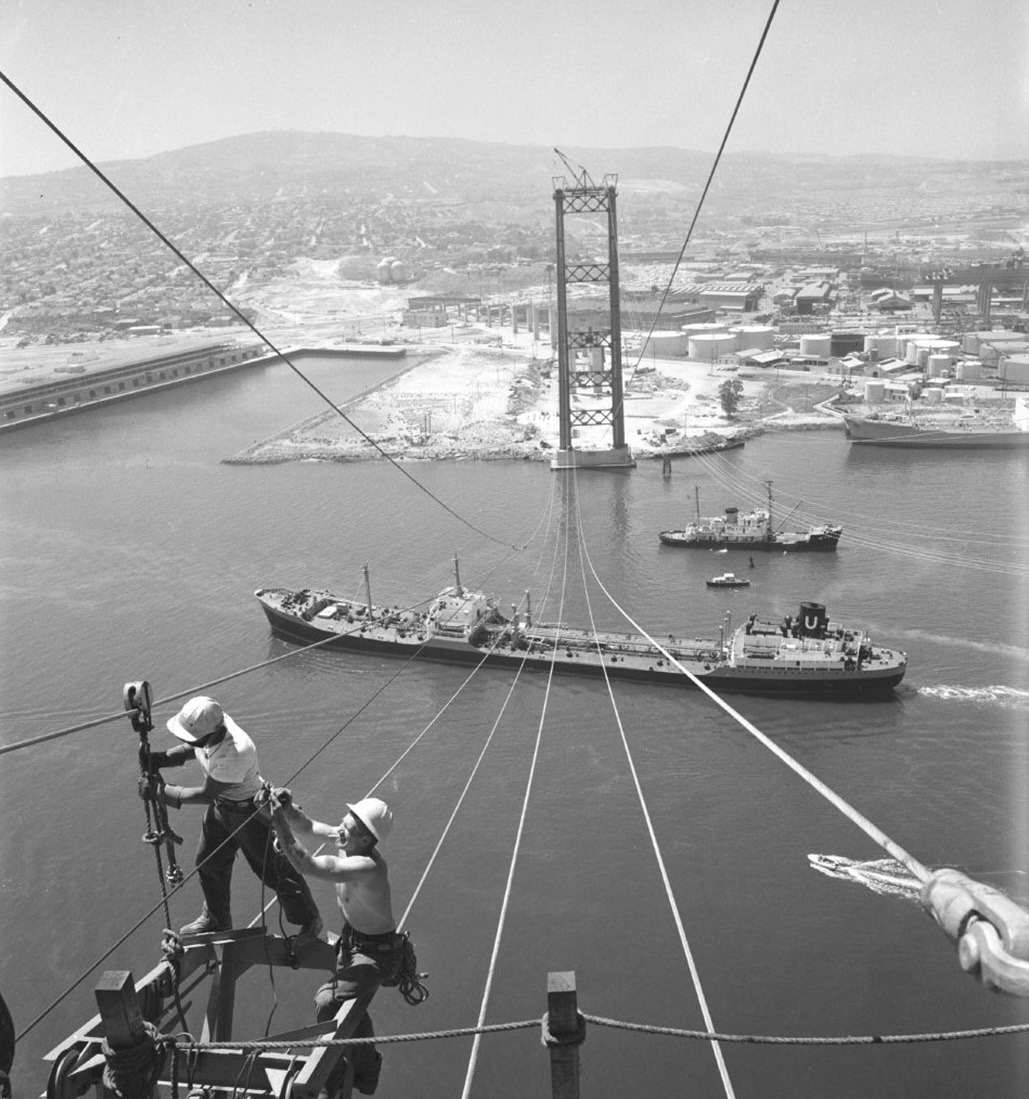
After the bridge was completed in 1963, many fish cannery workers, particularly women, fought to keep the night ferry service running. The replacement bus route added significantly more time to their commutes. In 1961, even before construction was finished, the California State Assembly officially named the crossing after Vincent Thomas, who was the longest-serving member of the Assembly at the time of the decision.
Technical Specifications
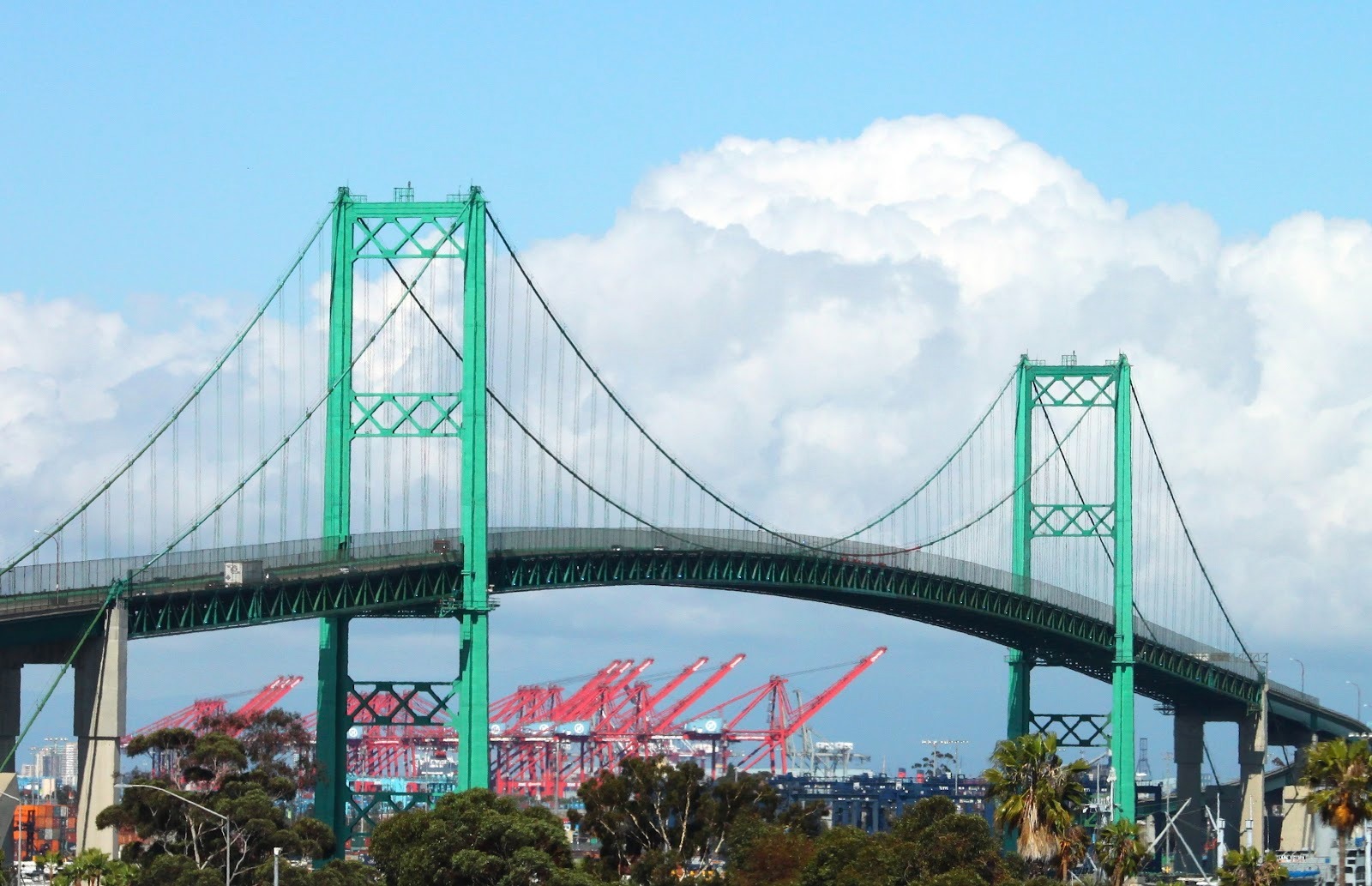
The Vincent Thomas Bridge is a suspension bridge for vehicular traffic with an overall length of approximately 1.8 kilometers (1.13 miles). Its main span stretches 457 meters (1,500 feet), and the steel towers reach a height of about 111 meters (365 feet). The roadway is about 16 meters (52 feet) wide, allowing for heavy traffic flow between the main port hubs. The bridge’s structure was designed to withstand significant wind and traffic loads. Engineers estimate it can resist wind gusts up to 145 kilometers per hour (90 miles per hour), substantially exceeding the standard requirements for the region.
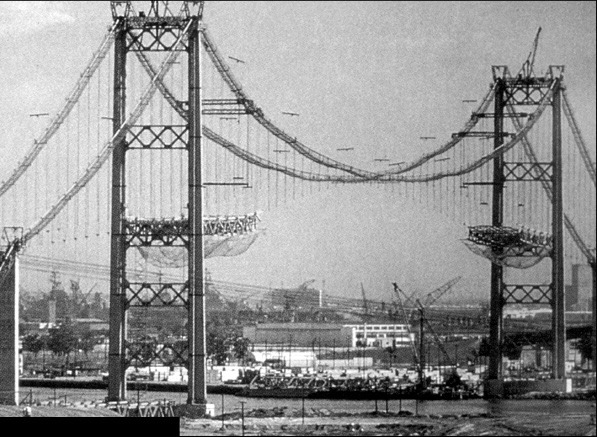
The bridge’s core is a suspension system, traditional for such structures, but executed with local specifications in mind. Massive steel main cables support the roadway deck via a system of vertical suspender ropes. The deck itself consists of steel girders topped with a lightweight concrete surface, which ensures optimal structural weight and uniform load distribution. The steel towers anchor the main cables and transfer the load to the foundation. This layered steel-and-concrete construction makes the bridge durable and resistant to long-term operational stress.
One of the most fascinating features of the Vincent Thomas Bridge is its foundation: unlike most suspension bridges that rely on massive concrete footings, this bridge is entirely supported by piles. This innovative solution offered several key advantages: reducing the impact on navigation in the harbor, enabling construction on a challenging seabed without building artificial islands, and providing long-term durability and stability through a system of load-distributing piles. This approach made the bridge a global first and an engineering case study for adapting suspension designs to unique coastal conditions.
During construction, over 14,000 tons of structural steel were used, along with large volumes of reinforced concrete for the piles and supports. Specialized welded elements were also employed, as the bridge was the first welded suspension bridge in the United States. The steel structures and suspension system were engineered to withstand both vertical and lateral loads typical of a high-wind port area.
A navigational clearance of about 56-57 meters (185 feet) is maintained beneath the bridge, allowing passage for large container ships, cruise liners, and military vessels. The suspension design was crucial in maintaining the required height while ensuring sufficient rigidity of the bridge deck.
The Vincent Thomas Bridge holds immense importance for the infrastructure of Los Angeles. It stands as the world’s first example of a pile-supported suspension bridge. It is a critically important route for cargo moving through the Ports of Los Angeles and Long Beach. Furthermore, it serves as an architectural symbol, on par with other iconic California bridges. The structure is built to withstand extreme wind loads and adheres to strict seismic standards.
Expansion of the Transport Network
In 1968, the bridge gained a direct connection to the Harbor Freeway (Interstate 110). This link proved to be a game-changer for the port; during the rapid growth of container shipping, the bridge’s presence ensured the efficient movement of freight.
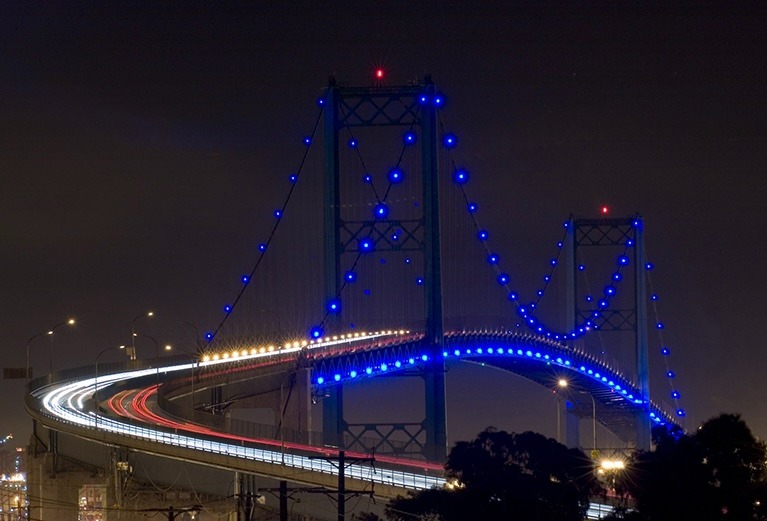
For the bridge’s 25th anniversary in 1988, a public fundraising campaign was launched to install decorative lighting on the main cables. In 2005, after 17 years of development, 160 blue LED lamps powered by solar panels were installed on the bridge. The project cost approximately $1 million. In 2023, Caltrans announced a major plan to replace the bridge deck, with an estimated cost of $706 million.
When the bridge opened in 1963, the toll was 25 cents in each direction. In 1983, the westbound toll increased to 50 cents, and the eastbound toll was eliminated. Finally, in 2000, the toll was abolished entirely. Following this, the San Diego-Coronado Bridge, another Southern California crossing, discontinued its toll in 2002, marking the region’s complete transition to free crossings.
The Bridge in Film and Video Games
The Vincent Thomas Bridge has become an iconic fixture in popular culture, appearing in dozens of films, series, and games. You can spot the bridge in movies such as “Gone in 60 Seconds” (1974 and 2000), “Lethal Weapon 2” and “Lethal Weapon 4,” “To Live and Die in L.A.,” “City of Angels,” “Charlie’s Angels,” “Inception,” and “Den of Thieves.” Notably, in the 1995 film “Heat,” Robert De Niro mistakenly refers to it as the “St. Vincent Thomas Bridge.”
The bridge is also featured in several video games:
- “Grand Theft Auto: San Andreas” (as the Ocean Docks Bridge);
- “Grand Theft Auto V” (as the Miriam Turner Overpass);
- “Need for Speed: Most Wanted”;
- “Need for Speed”;
- “The Crew” and “The Crew 2.”
Regrettably, the bridge also has a dark side to its history. According to the Los Angeles Police Department, suicide attempts occur every few months. The most famous case was the death of director Tony Scott, who jumped from the bridge on August 19, 2012. Another tragedy occurred in 1990 when Larry Andreasen, a bronze medalist in diving at the 1964 Olympics, died while attempting a record-setting jump from the bridge’s west tower.
The design of the Vincent Thomas Bridge is a unique blend of engineering audacity and technical precision. Its suspension system, steel towers, pile-based foundation, and significant strength reserves make it one of Southern California’s most vital infrastructure assets. The bridge not only serves thousands of drivers daily and supports the operations of the largest port in the US but also remains a prime example of how engineering can shape cities and their future.