

Park · Los Angeles · ⭐ 9.5/10 · 69628 reviews · updated: 2026-08-04 16:03:16
Address: Los Angeles, CA 90027, United States
Griffith Park — Mountain Wilderness Inside the City
Few big cities keep an entire mountain range in the middle of themselves. Griffith Park spreads over more than 4,200 acres of chaparral ridge, oak-shaded canyon and hilltop landmark between the Los Feliz neighborhood and the San Fernando Valley — roughly five times the area of New York’s Central Park, and the largest municipal park in the United States that still holds genuine wilderness inside its boundary. Coyotes cross the fire roads at dusk, rattlesnakes sun themselves on the switchbacks, a copper-domed observatory glows above the basin, and the Hollywood Sign sits on a ridge that belongs to the park itself. It is the rare place that works equally well as an hour’s walk before dinner and as an all-day expedition with a summit at the end of it.
Highlights
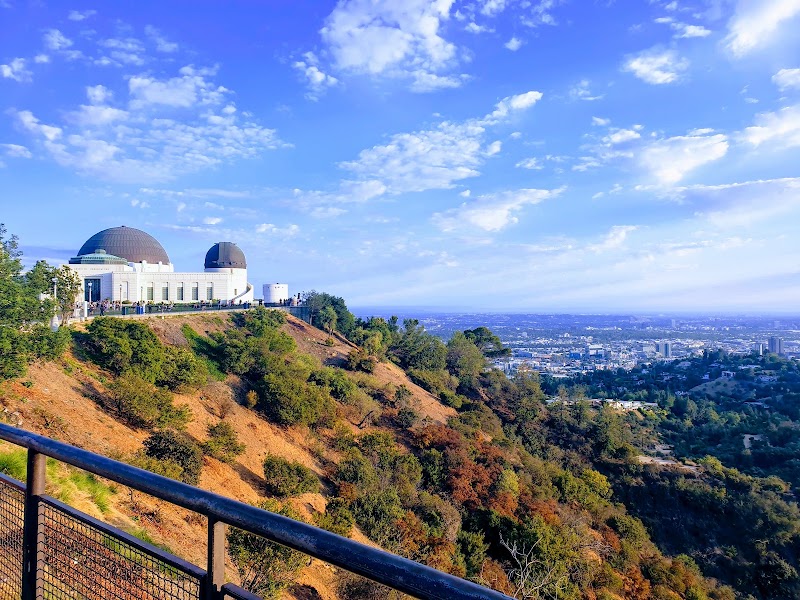
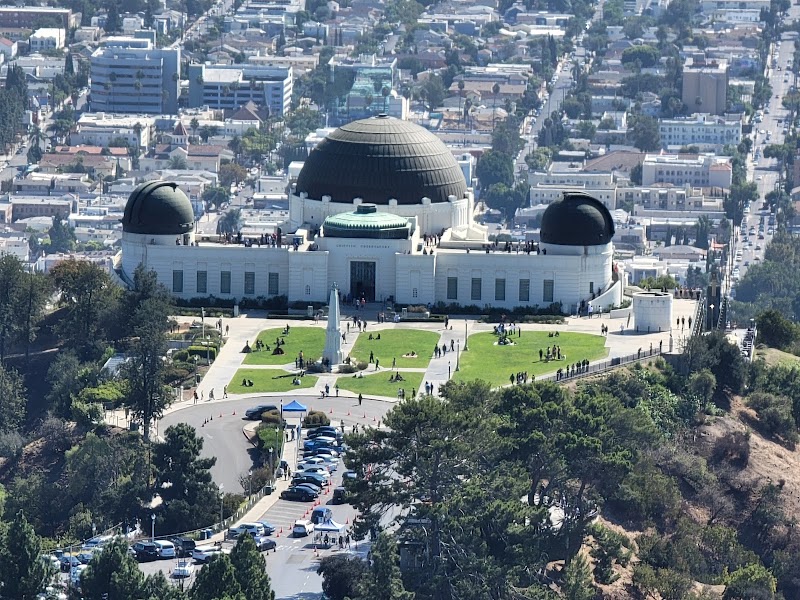
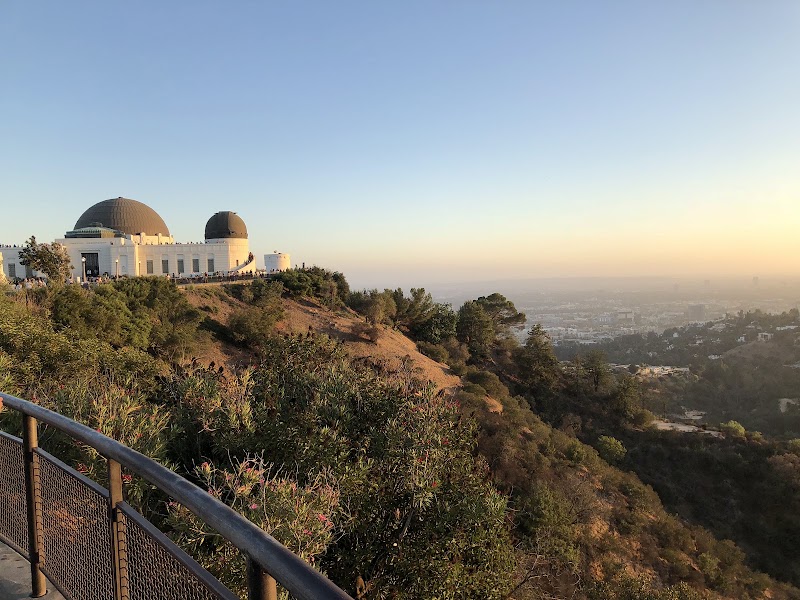
- Griffith Observatory — opened on May 14, 1935 and free to enter ever since, exactly as its founder’s will required. Its 12-inch Zeiss refractor has been looked through by more than nine million people, more than any other telescope on Earth; the rotunda holds a Foucault pendulum, and a Tesla coil built in 1910 by aviator Earle Ovington still throws sparks on schedule.
- The Big Picture and the Samuel Oschin Planetarium — the largest astronomically accurate image ever assembled, 152 feet long and 20 feet high on 114 porcelain-enamel plates, showing nearly a million galaxies in the Virgo Cluster; next door, a 75-foot aluminium dome runs shows on a Zeiss Universarium Mark IX projector installed during the great renovation.
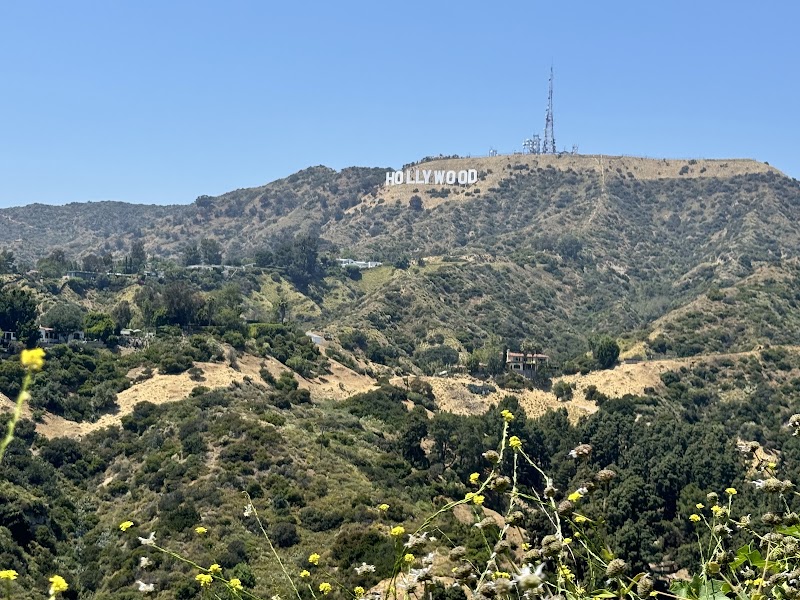
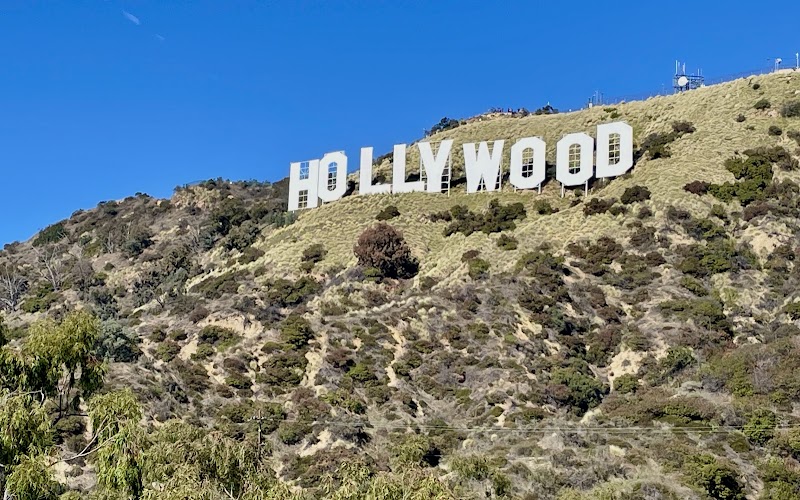
- Hollywood Sign viewpoints — the Charlie Turner trailhead beside the Observatory climbs to Mount Hollywood, at 1,625 feet the park’s best-known summit; the sign itself stands on Mount Lee inside the park, and Cahuenga Peak behind it, at roughly 1,820 feet the highest ground here, was bought and added to the park in 2010 after a public fundraising campaign.
- Los Angeles Zoo and Botanical Gardens — opened November 28, 1966 across 133 hillside acres, holding more than 270 animal species and a botanical collection of some 800 plant species. It is a core partner in the California condor recovery programme, which has lifted the species from 22 surviving birds in the 1980s to more than 500, and its LAIR reptile and amphibian complex opened in 2012 with 49 separate habitats.
- The Greek Theatre — an open-air amphitheatre built with money left by the park’s founder, dedicated on September 25, 1930 and seating close to 5,900 people in a wooded hollow of pine and oak for the summer concert season.
- Travel Town Museum — dedicated December 14, 1952 and founded by a parks employee, Charley Atkins; a free open-air yard of 43 full-size locomotives and cars running from an 1864 American-type engine to 1960s diesel switchers, with a separate narrow-gauge miniature railway circling the grounds.
What you’ll find
The park is really a chain of small, distinct worlds strung along canyon roads and fire roads, and most visitors only ever meet two or three of them in a lifetime of visits.
- Ferndell, a cool shaded glen where a man-made stream runs among ferns, stone bridges and imported tree species — the gentlest possible way into the hills, and the start of a walking route to the Observatory.
- The Old Zoo, whose stone grottoes and barred cages from 1912 to 1966 stand empty and open above a wide picnic lawn that hosts free open-air Shakespeare through the summer.
- The Autry Museum of the American West, founded in 1988 by Gene and Jackie Autry, holding one of the deepest collections of Western art, film history and Native American material anywhere in the country.
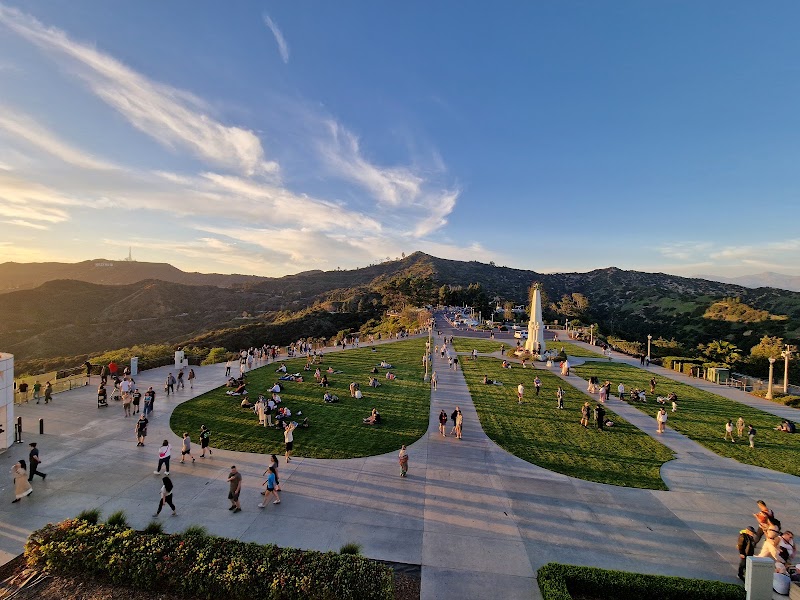
- The Astronomers Monument on the Observatory lawn — a 35-foot concrete obelisk raised in 1934 as a New Deal public art project, with six sculptors each carving one figure: Hipparchus, Copernicus, Galileo, Kepler, Newton and Herschel.
- Bronson Caves, a short walk to the mouth of an abandoned rock-quarry tunnel that played the Batcave in the 1960s Batman series and stood in for the desert West in hundreds of films before it.
- Two full-length public golf courses, tennis courts, ballfields, bridle paths, working stables on the Valley side, and a miniature train, the Griffith Park Southern Railroad, that has circled the same meadow since 1948.
Things to do — and who it’s for
- Hikers and trail runners — more than 50 miles of trail, from paved lookout paths to steep single-track over the ridgelines, a network large enough to walk for hours without repeating yourself and with a view at the top of nearly every climb.
- Families with small children — the zoo, the free railroad yard, the miniature railway and the shaded picnic lawns sit within a few minutes of one another, so a whole day passes without moving the car twice.
- Stargazers — free public telescope viewing on clear evenings, monthly star parties run by local astronomy clubs on the front lawn, and planetarium shows under the Oschin dome.
- Concert-goers — a summer season at the Greek Theatre where the audience walks downhill through trees to reach the stage, and the acoustics come partly from the hillside itself.
- Cyclists and riders — long canyon roads with real gradient and a separate network of bridle trails, both at their best in the first hours after opening, before the parking lots fill.
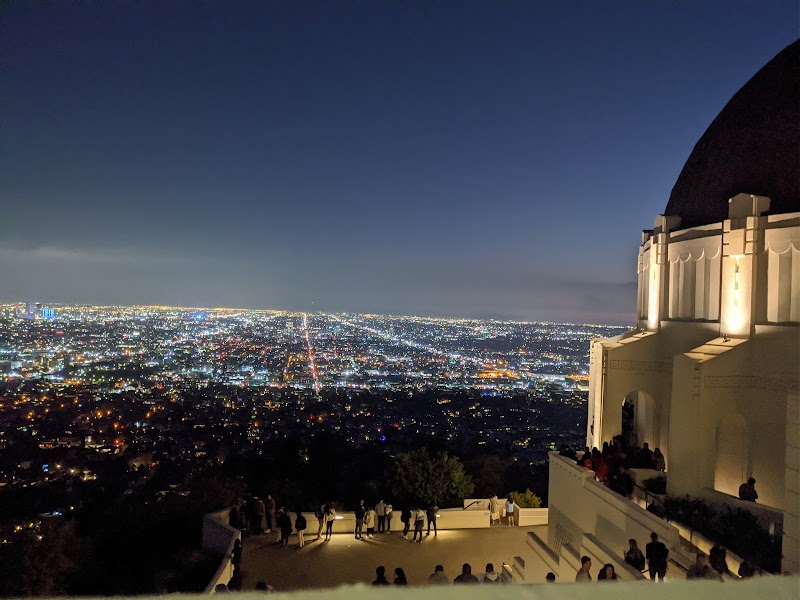
- Photographers and film pilgrims — golden hour on the Observatory terrace, the Rebel Without a Cause locations from 1955 and the La La Land viewpoint, plus coyotes, mule deer, red-tailed hawks and the occasional bobcat for anyone who arrives early enough.
Getting there & practical
The main gateways sit in Los Feliz on the eastern side and on the Valley flank to the north, and the two halves of the park feel like different places — museums, zoo and railroad yard to the north, observatory and steep trails to the south. Without a car, take the Metro B Line to the Vermont/Sunset station and change to the low-cost DASH Observatory shuttle, which climbs the hill and stops at the Observatory door; it runs into the late evening and removes the single worst problem of a visit, which is parking. Entry to the park is free, and so is the Observatory itself — but parking beside it is paid, and planetarium shows are ticketed separately. The zoo and the Autry Museum charge admission; Travel Town does not. The park is open daily from 5 a.m. to 10:30 p.m., all trails close at sunset, and the Observatory is dark on Mondays, opening at midday on weekdays and mid-morning at weekends. Allow two to three hours for the Observatory alone, half a day for a walk plus one attraction, and a full day if the zoo or a museum is on the list. Water and shade are scarce once you leave the paved areas, and the ridges have no drinking fountains at all.
When to visit
Winter is the local secret: Pacific storms scrub the air clean, the hills turn green within days of rain, and from the Observatory terrace the snow line on the San Gabriel Mountains is visible past the downtown towers — though days are short and the trails close early. Spring, roughly March to May, is the best hiking window of the year, with wildflowers on the south-facing slopes, green grass on the fire roads and temperatures that make the long climbs pleasant rather than punishing. Summer is hot and bone-dry, the hills going the colour of straw by July; walk before nine in the morning or come for the evening instead, when the Observatory stays open late, the terrace fills with people and the city lights switch on beneath you. Autumn delivers the sharpest views of the year after the first cool nights, but it is also the peak of fire season: on Santa Ana wind days under a red-flag warning the city closes the entire park, sometimes at a few hours’ notice, as it did repeatedly during the January 2025 windstorms, so check the status before setting out. The park itself did not burn in those fires and is open normally, but the closures are real and they arrive fast.
Good to know
Griffith J. Griffith, born in Wales in 1850, arrived in California as a mining journalist, made a fortune advising on mining investments, and in 1882 bought a large share of Rancho Los Feliz, where he ran an ostrich farm for a time. On December 16, 1896 he handed 3,015 acres of it to the City of Los Angeles as a Christmas gift, insisting that it must be “a place of recreation and rest for the masses, a resort for the rank and file, for the plain people,” and that neither race, creed nor colour should keep anyone out. His later life was darker: in 1903, in a Santa Monica hotel room, he shot and wounded his wife, served two years in San Quentin, and returned to a city that no longer wanted his name on anything. The money he offered for an observatory and a Greek theatre was accepted only after his death in 1919 — the Greek Theatre followed in 1930, the Astronomers Monument in 1934 and the Observatory in 1935, all of them built through the worst years of the Depression. Later acquisitions, including the 2010 purchase of Cahuenga Peak behind the Hollywood Sign, pushed the park past 4,200 acres. Its history has darker chapters too: parts of the park held detention camps during the Second World War, a fire in October 1933 killed 29 relief workers on a brush-clearing crew, and a fast-moving fire in May 2007 burned more than 800 acres of the eastern hills. The Observatory’s own great modernisation closed it from January 2002 to November 2006, adding an underground exhibition floor and a new theatre. And the park has its folklore: the mountain lion P-22, who crossed two freeways as a young cat and then lived alone in these hills from 2012 until 2022, and the fact that Griffith Park is regularly the busiest filming location in Los Angeles, with hundreds of production days a year.
Visitor tips
- The Observatory lot fills by early afternoon at weekends and the approach roads back up behind it; park lower down and walk the last stretch, or take the DASH shuttle from the Metro station and skip the queue of cars entirely.
- Carry more water than seems necessary and start early — the ridges have no shade and no fountains, the climbs are steeper than they look from below, and rattlesnakes are active on warm afternoons.
- The historic merry-go-round has been closed since 2022 and is under restoration after the city bought it in 2025, so do not build a family visit around it; the zoo’s own carousel and the miniature railway are running instead.
Questions & answers
Is Griffith Park free? Yes — both the park and the Observatory cost nothing to enter, a condition of the founder’s original gift. Parking at the Observatory, planetarium shows, the zoo and the Autry Museum are ticketed separately; Travel Town is free.
Can you see the Hollywood Sign from the park? Yes, from many points. The Observatory terrace gives the easiest view; Mount Hollywood gives the best one for the effort of a short climb; and the sign itself stands on Mount Lee, which is inside the park.
Is the merry-go-round running? No. The 1926 carousel, on this site since 1937 and the ride Walt Disney watched his daughters use, closed in 2022. The city purchased it in 2025 and a multi-year restoration is under way.
How do I get there without a car? Take the Metro B Line to Vermont/Sunset and change to the DASH Observatory shuttle, which runs up the hill to the Observatory entrance and back into the evening.
How long should I allow? Two to three hours for the Observatory alone, half a day with a hike added, and a full day if you include the zoo or a museum. The park is far too large to see in one visit.
Do the trails ever close? Yes. Every trail closes at sunset, and the entire park can shut during red-flag wind events in fire season, occasionally with only a few hours’ warning.
Is there anything free besides the Observatory? Travel Town, the Astronomers Monument, Ferndell, the Old Zoo picnic grounds, the whole trail network and the summer Shakespeare performances all cost nothing.
What was P-22? A male mountain lion who crossed two freeways to reach the park and lived here alone from 2012 to 2022, becoming the emblem of the campaign for wildlife crossings across Southern California.
Photos
Show 1 more photos
Visitor reviews
Reviews last updated: 2026-08-04 16:03:16
Data is refreshed monthly. Sources: los-angeles.name and editorial picks based on reviews.
A place where you can enjoy the view.
A beautiful view, the observatory is interesting too, and it's also a place from favorite movies
What a panorama of Los Angeles. An interesting tour.
from Griffith Observatory to the "Hollywood" sign i decided to walk on foot across all the hills of Griffith Park… there are actually two routes — the lower one and the upper one. i chose the second option. so from a (…