

When the Earth trembles, instruments in laboratories around the world spring to life—instruments created by a man who taught us to hear the planet’s heart. His name was Hugo Benioff, a Californian with the soul of an inventor. He succeeded in transforming seismology from a descriptive science into a precise field of physics. He revealed to the world that patterns exist even deep beneath the oceans and continents, and that earthquakes are not the chaotic whims of nature, but a language our planet speaks. His life is a story of persistent inquiry, combining engineering mastery, a philosophy of simplicity, and a deep sense of humanity. Benioff left behind not just instruments, but entire branches of science that changed our understanding of the Earth’s structure. His work remains relevant well into the 21st century. Read the story of his developments and research in this article at los-angeles.name.
Biography
The future scientist Hugo Benioff was born in Los Angeles to a family with multinational roots. Even as a child, he felt a deep love for nature and an inclination toward science. At fourteen, Benioff dreamed of a career as an astronomer, spending hours gazing at the stars in the California sky and building his first instruments from makeshift materials.
His path to science began in the public schools of Los Angeles and Long Beach. He later enrolled at the prestigious Pomona College, where he demonstrated remarkable ability, becoming a member of the Phi Beta Kappa honor society and earning a Bachelor of Arts degree in 1921. As a student, he spent his summers working at the Mount Wilson Observatory, assisting astronomers with solar observations. However, the cold nights and sleepless hours under the telescope dome convinced him that the science of the stars was not his true calling.
From the Stars to the Earth’s Depths
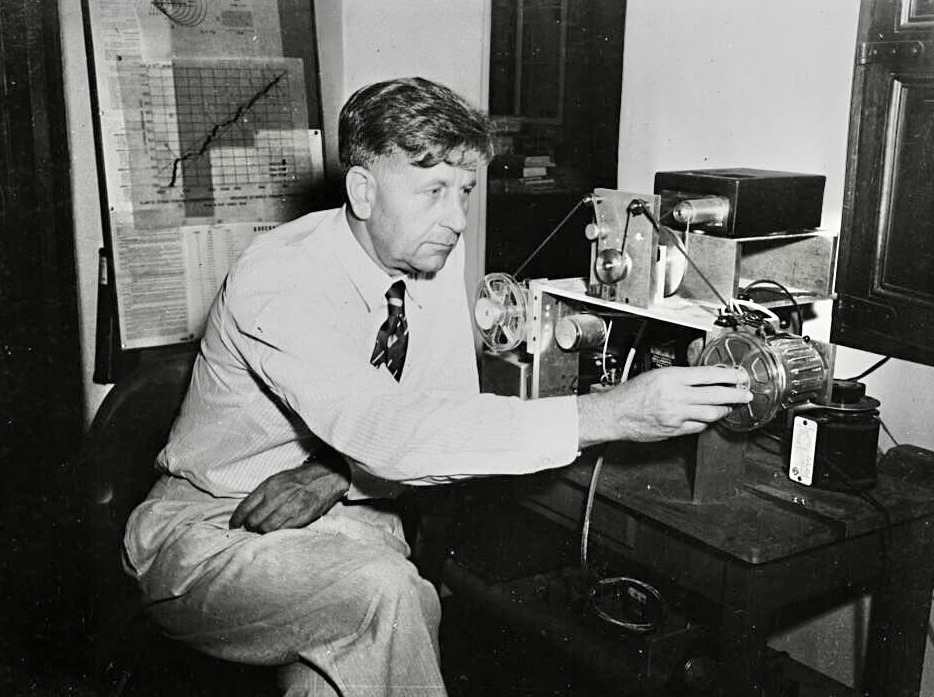
After a brief attempt at working at the Lick Observatory, Hugo shifted to a completely different field: seismology. In 1924, he joined the Seismological Program of the Carnegie Institution in Pasadena. His first task was technical: to design a new drive for the drums that recorded ground vibrations. But even this routine job became the start of an epochal breakthrough. Benioff created a unique impulse motor that could record tremors with an accuracy of one-tenth of a second. This very development marked the birth of the legendary California seismological network. Benioff installed most of the first instruments and helped create a monitoring system that would become one of the most advanced in the world.
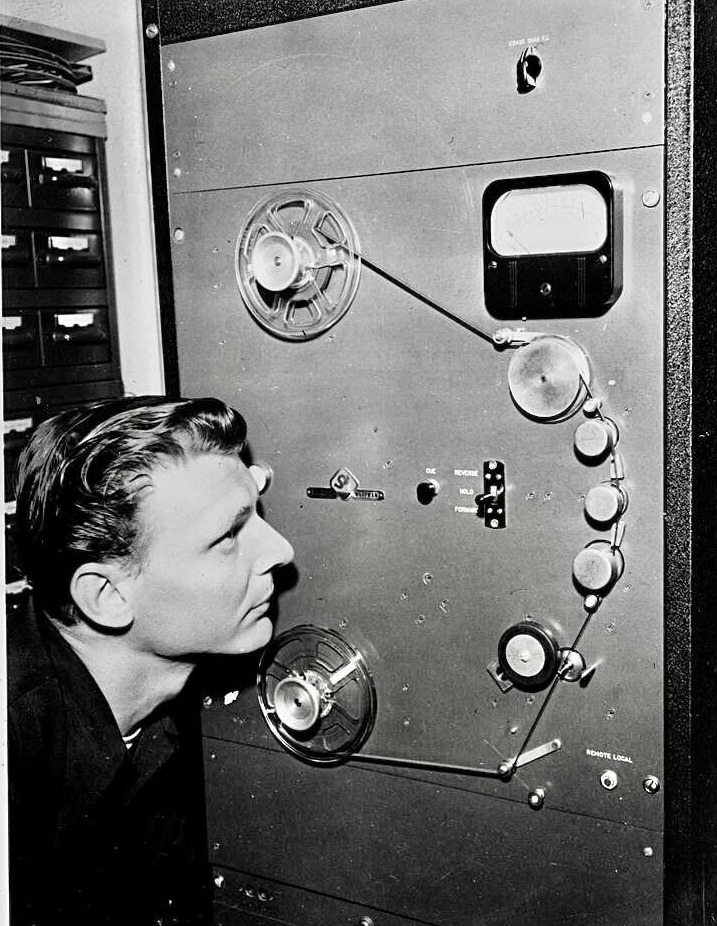
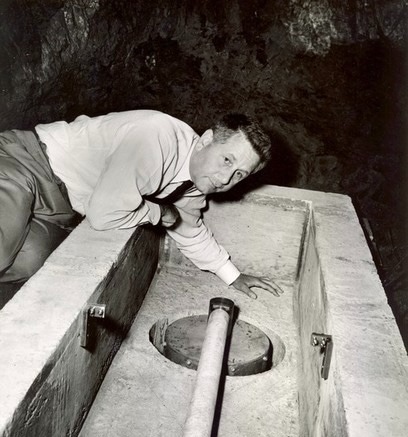
In the 1930s, Hugo Benioff created the device that would make his name famous in the scientific world: the variable-reluctance seismograph. This instrument, capable of recording even the slightest vibrations, opened a new era in earthquake studies. His invention made it possible to accurately determine the arrival times of seismic waves, detect new types of tremors, and extend the magnitude scale to distant, teleseismic events. The instrument became the standard for seismic stations globally and was even recommended by the Geneva Conference as the basis for a nuclear test monitoring system. The scientist’s second major invention, the linear strain seismograph, helped record the Earth’s mantle’s surface waves for the first time. This allowed us to understand how the planet oscillates after massive earthquakes.
Professor of Seismology
In 1935, Benioff earned his Ph.D. from the California Institute of Technology and soon became a professor of seismology. He rarely lectured, but his influence was felt everywhere. Graduate students and colleagues alike learned from him how to think simply about complex problems. It was during those years that the Pasadena laboratory transformed into a world center for geophysics. Alongside Beno Gutenberg and Charles Richter, the author of the famous scale, Benioff laid the foundations for our modern understanding of earthquakes.
During World War II, his team worked on underwater detection systems and radar devices for the U.S. Navy. But after the war, the scientist returned to his main passion: studying the Earth. He experimented with new ways of recording tremors, developed magnetovariographs to study micro-pulsations of the magnetic field, and created the first anti-seismic standards, which prioritized the ground acceleration spectrum as the key parameter.
In the 1950s, Benioff turned to the grandest mystery of all: the nature of global tectonics. Long before the theory of plate tectonics was formally established, he proposed the idea of stress accumulation and release in the Earth’s crust. He explored the connection between aftershocks and stress relief and suggested that the locations of epicenters reflect the structure of deep faults. He was the first to show that large earthquakes form regular patterns, now known as Benioff zones. His research became foundational to the new global tectonics, and Benioff himself became one of the key figures who propelled modern geophysics forward.
Benioff’s restless nature was not limited to science. He designed lightweight bicycles, studied lens optics, and even created an electronic cello and piano, working on the latter with the Baldwin Piano Company. His imagination blended technical precision with a love for the arts.
Awards
Hugo Benioff received numerous awards and honors for his achievements in seismology and geophysics. His contributions to science were recognized by national and international organizations. In 1953, Benioff was elected a member of the National Academy of Sciences, one of the highest honors for scientific achievement in the United States. In 1957, he received the Arthur L. Day Medal from the Geological Society of America. This award is given for outstanding distinction in applying physics and chemistry to geological problems. In 1965, Benioff was awarded the William Bowie Medal by the American Geophysical Union. This medal is the organization’s highest honor, recognizing outstanding contributions to fundamental geophysics and unselfish cooperation in research. In 1958, Benioff was elected a Fellow of the American Academy of Arts and Sciences. In 1965, he also received the Medal of the Royal Astronomical Society, highlighting his contribution to the advancement of astronomical research. Despite his numerous accolades, Hugo Benioff remained exceptionally modest. He was a man of liberal views, compassionate toward the less fortunate, and always ready to help a student or a stranger. In his free time, he would escape to the California wilderness, buying plots of land he found beautiful and setting up ranches where he could relax and recharge.
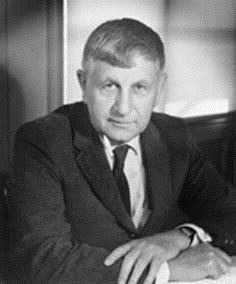
In 1964, Benioff retired, becoming a professor emeritus at the California Institute of Technology, and settled on the coast near Cape Mendocino. There, he grew vegetables, cared for animals, and continued to write articles for scientific journals, often hosting colleagues in his home. He passed away on February 29, 1968, at the age of 68. His life is an example of how one person can combine science, humanity, and a love for the world. Benioff’s instruments are still at work, his graphs are still studied by young geophysicists, and the term “Benioff zone” has become an indispensable part of every seismologist’s vocabulary. His legacy lies not only in his inventions but in his very approach to discovery: to seek simplicity in the complex, to never fear new ideas, and to listen to the Earth as it speaks.