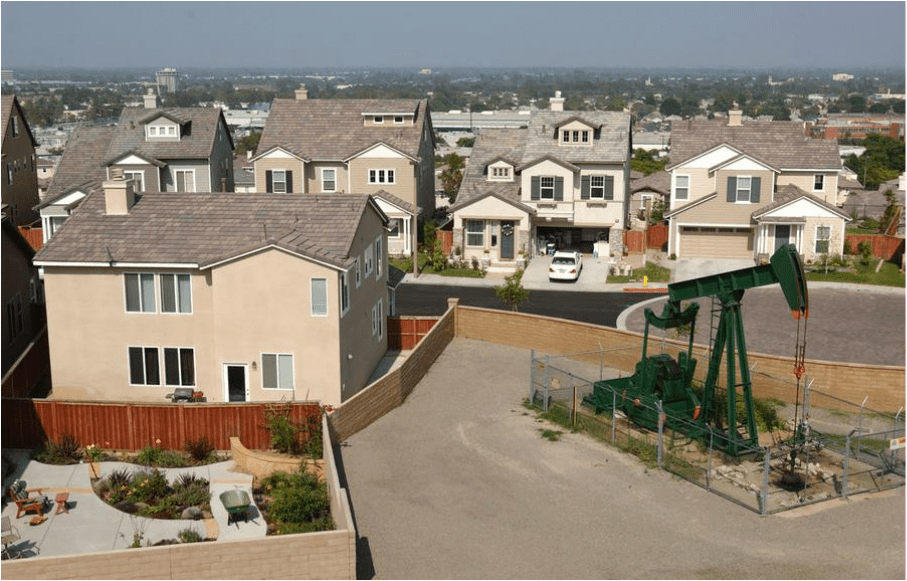
During the city’s development, the period of oil extraction is often called the “dark days”. Los-Angeles.name will tell more about those times and the peculiarities of oil production in the region.
Effortless process of oil production
Originally oil in Los Angeles was freely accessible. At the same time, extraction and residential zones were separated. The history of oil production began back in the 1890s when the population of Los Angeles reached 50 thousand people. It was then that some of the most productive deposits were unearthed.
California managed to reach an unbelievable level by 1930, producing nearly a quarter of the world’s crude oil. By then, there were over 1.2 million inhabitants in the city.
Oil output at that time can be described as follows:
- easy access
- minimal regulation
- lack of understanding of the impact of oil production on the environment or human health.
The largest urban oil field
Los Angeles currently has thousands of active oil wells, considering the city’s population of over 10 million people. Signal Hill in California is one of the largest urban oil fields.
The extraction of crude in the city began in 1919 when fuel deposits were initially discovered. The giant Long Beach Field reservoir is the eighth largest in total production in California. In the 1920s, the field was highly rich, with hundreds of oil derricks supplying the needs of the residents of Signal Hill and surrounding areas of Long Beach.
Even though the land was reused many times, this reservoir continues to be productive. Oil wells are surrounded by commercial and housing development.
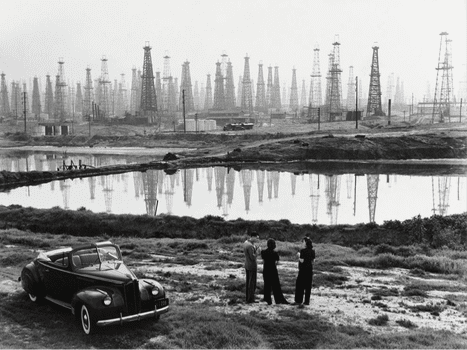
Waterflooding and oil field leases
Waterflooding is a process of water injection into an oil reservoir. Thus, pressure increases, facilitating the production of petroleum. 30% of oil can be extracted from the formation on average. However, this method just helps to sustain the production capacity for a long period of time.
In the 1940s, land settlement in the Long Beach and Signal Hill areas caused cracks in the walls and foundations of buildings. Sewer and underground pipes were also damaged. Subsequent investigations revealed that petroleum output had impacted approximately 21,600 acres of land. In 1955, Charles S. Jones proposed a Waterflood solution. By the mid-1960s, six blocks at the fault spots were put and the subsidence of land was ceased. This, in turn, increased oil production.
It is interesting that some of the lease agreements on oil fields date back to the 1920s. It should be noted that the property owner cannot start construction until the contract is renewed or removed from the property.
Stock reduction
Oil reserves have reduced, yet drilling in Los Angeles remained unchanged. Derricks, hidden from the eyes of citizens and tourists, are scattered throughout the city. They are often placed behind high rise buildings or in deprived areas. For instance, more than 3.8 million people live within a quarter of a mile from a non-operated or active oil well.
Over time, the available fossil fuel reserves have decreased in Los Angeles, leading drillers to employ extreme and sometimes even hazardous methods of oil extraction. There are cases of such production in the middle of residential areas, for example:
- oil output in the city near McDonald’s
- a hidden derrick operating near the sports ground and Beverly Hills High School
- a camouflaged derrick with 40 active wells in the Beverly Hills oil field (Cardiff Tower) on West Pico Blvd.
There are plenty of such instances. According to experts, the presence of oil facilities in close proximity to residential areas is probably a historical coincidence or a zoning mistake. Either way, it is dangerous.