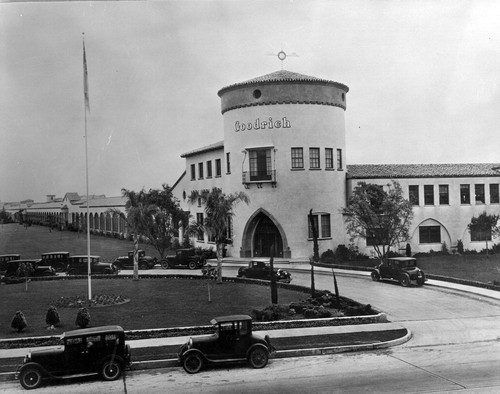
One of the driving forces behind Los Angeles’ great 20th-century economy was heavy industry. It was growing rapidly. Thus, tire manufacturing was a thriving industry in the 1920s. Los Angeles Name tells more about this.
Launch of the plant
An article about the opening of a new plant can be found in the local newspaper LA Times, dated May 10, 1927. The press campaign, the size, scale and cost of the factory should have attracted the attention of the public.
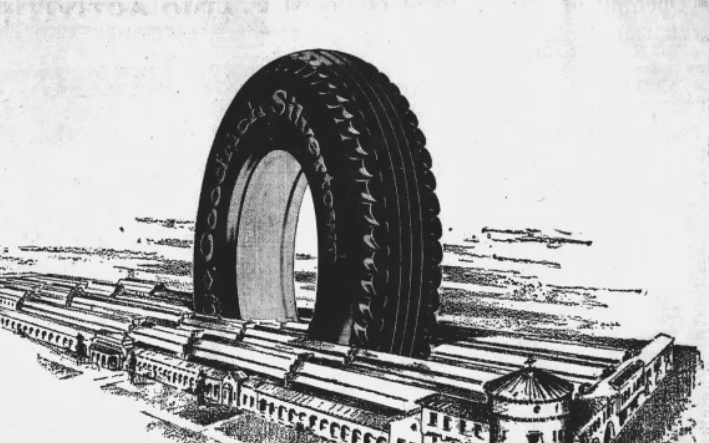
The story of Goodrich at Goodrich and Olympic Boulevard is interesting. It is one of the most huge plants of that period. In the local press, it was called the beginning of a new era of large-scale heavy production. This was true compared to other tire factories like Goodyear built in South Gate.
The cost of the enterprise was estimated at $4,000,000. The plant occupied 45 acres. Its opening enabled many people to find employment. The number of tires produced per day exceeded thousands.
It is worth mentoring its style. The facilities were built by the Foundation Company, adhering to the features of the Spanish Colonial Revival style. This made it exceptional because the industry showed no interest in the aesthetic side of buildings. Quantitative and qualitative indicators were valued but not aesthetics.
The editors of the LA Times wrote that the chosen contractor was the biggest at the time.
The first stone
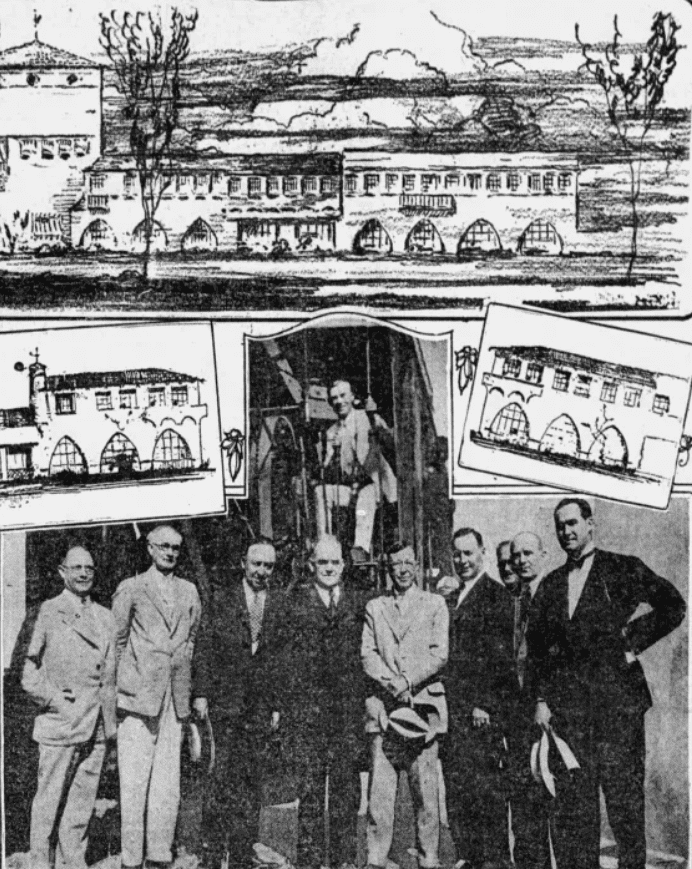
The press campaign together with the attention of high-ranking persons added public interest to the plant. Thus, Mayor George E. Cryer (served 1921-1929) was present at the ceremony of laying the foundation stone of the future plant. He posed for the photos and joined other county leaders and officials.
Impressive size of the tire factory
The B.F. Goodrich Rubber Company was the parent organization. At that time, the local facility was under the protection of the Pacific Goodrich Rubber Company subsidiary. From the very beginning, it was planned to build a tire plant on the territory of the Union Pacific Tract.
The president B.G. Work explained to the local publication LA Times that the tire factory also had production centers in Canada, England and France. Therefore, the decision to build a plant in LA was quite obvious because the city was focused on car production and usage. Statistical analysis showed that about 40% of all cars in California were concentrated in the city.
Initially, it was predicted to be built on 10-15 acres, with the employment of 1,000-1,500 people. Their projected salary per year was supposed to be $1.5-2 million.
The plan was to produce 5,000-7,500 tires per day.
In 1920, the Goodyear factory was built in the south-central part of LA. However, Goodrich surpassed the production capacity, cost and scale of its predecessor, earning the title of the biggest factory.
Getting started
In March 1928, the factory began to produce tires despite the fact that the construction continued. In parallel with these processes, thousands of schoolchildren came to the plant. It was a sightseeing tour aimed not only at familiarization but also at attracting new workers in the future.
The opening of the tire factory dates back to May 2, 1928. The event included a party in the directors’ office, as well as other festivities, such as radio broadcasts.
The very next day, the public got the opportunity to inspect and evaluate the scale of the huge factory. On May 4, the founders of the plant declared East Side Organization Day. It was an act of support for this project.
Forecasts were extremely optimistic. President James D. Tew said Goodrich will be able to serve eleven states, solving the problem of lack of inventory in the branches. Furthermore, the production activity and scale of the plant should significantly reduce delivery costs.
In his commentary to the local publication, James D. Tew also emphasized that a plant of this level was created in just 7 months. According to him:
‘This is a great demonstration of Pacific Coast efficiency. It embodies the spirit of progress and corresponding achievements, gaining the attention of the financial and industrial East.’
The employees also benefited from such a place of work and not only financially but also psychologically. The environment supported the activity of the tire plant in every possible way, understanding its significance. Accordingly, it was prestigious to be an employee of such a plant.
Closure of the tire factory
Despite the uniqueness of the tire plant and its scale, it became one of many to close in the East Side Industrial District. Heavy industry was going through hard times and the regional economy was struggling and took a new course of development.
An original postcard of the factory, dated November 4, 1928, has been preserved. The photo shows the large complex located at 5400 East Ninth Street. Later, the territory became the Olympic Boulevard because the Summer Olympics were organized in the city in 1932.
The appearance of the factory really differed from the usual buildings. The difference was obvious. It featured impressive architecture and a neatly arranged landscape.
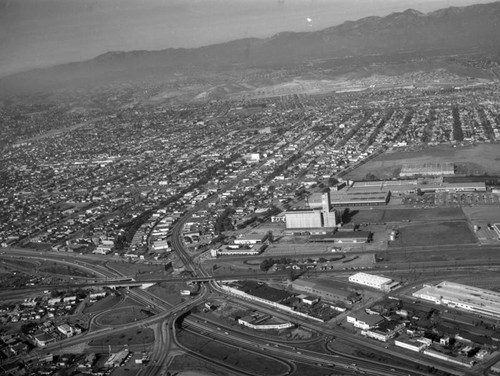
Still, those times are long gone because a commercial and industrial zone is located on the site of the largest tire factory.